The Best Form of Thiamine for Gut Health
If probiotics and fibre haven't improved your gut health, thiamine (vitamin B1) may be the missing piece of the puzzle. In Japan several thiamine derivatives have been developed, including one that appears to be particularly effective at supporting healthy gut motility.
To be honest, I first came across the idea that vitamin B1 deficiency could be linked to gut issues years ago.
But I ignored it because it sounded too simple to be true.
A couple of weeks ago I watched a YouTube video about it and decided to do some research this time.
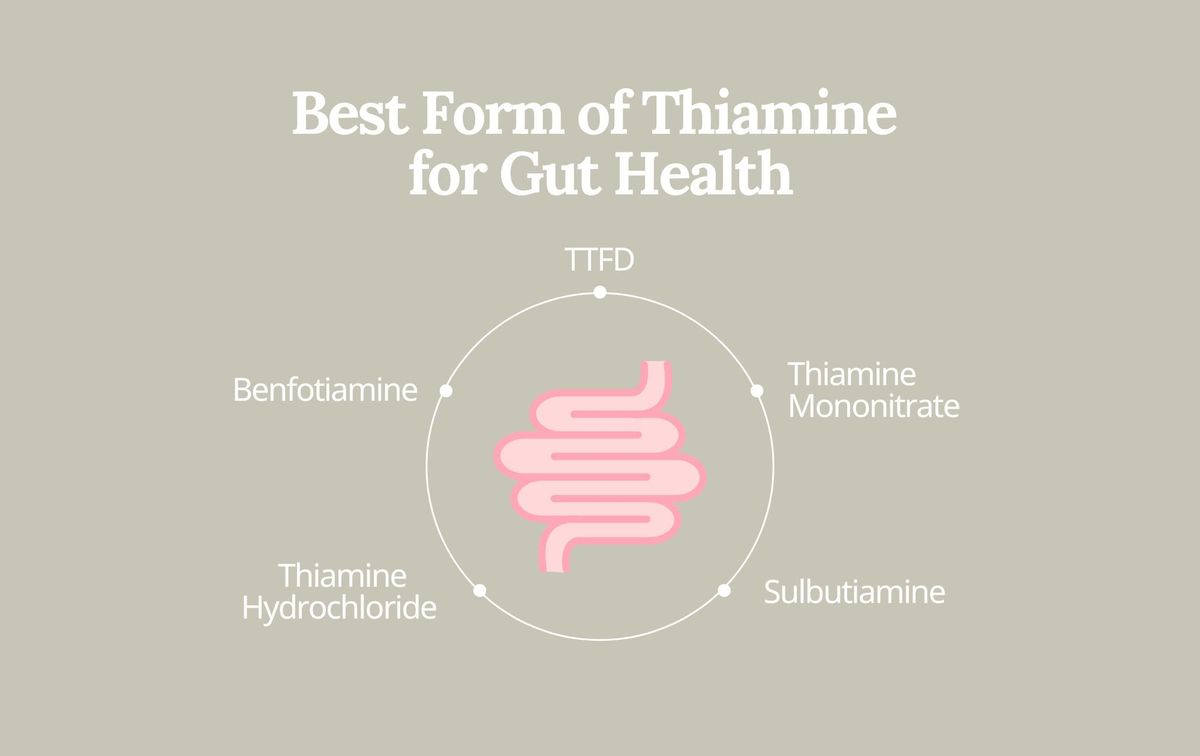
It seems that the form of thiamine matters a great deal, so I want to begin this series on vitamin B1 and gut health with a compact review of the different types and how they differ.
Thiamine Supplement Forms
Thiamine Hydrochloride and Thiamine Mononitrate
If you have ever taken a multivitamin or B-complex, these are likely the forms of thiamine you know.
They are usually the cheapest option but generally don’t work particularly well due to limited absorption.
You would also need relatively high doses to get the benefits for gut health.
Benfotiamine
This is a fat-soluble form (as opposed to the salts mentioned above) with a much better absorption profile.
TTFD
TTFD stands for thiamine tetrahydrofurfuryl disulfide.
It is considered the most advanced form of vitamin B1, because it is highly absorbable, can cross the blood-brain barrier and, in simple terms, doesn’t require the body to work hard to transport it into cells.
According to Elliot Overton, this form is very good at restoring motility and the most clinically relevant for gut problems such as SIBO.
Sulbutiamine
This is another fat-soluble form of vitamin B1. It’s mostly discussed in nootropics circles because it seems to have a positive effect on concentration, memory and mood.
Sulbutiamine is a thiamine derivative developed in Japan in the mid-60's as a beriberi treatment drug. Since then, different potential applications have been described. For instance, there is some evidence that sulbutiamine can have anti-fatigue, nootropic, and antioxidant effects, which led to its use as a sport supplement (although some authors argue it is actually a masking doping strategy).
The main issue with sulbutiamine is that its effects tend to wear off quickly.
Best Form of Vitamin B1 for Gut Issues
Although Elliot Overton suggests that TTFD is the best form of thiamine for gut problems, he also mentions the paradoxical reaction.
Sometimes people who need thiamine the most react badly to it, especially the more bioavailable forms such as benfotiamine and TTDF.
The solution is to start with thiamine hydrochloride, which sounds counterintuitive, but prepares the body for more potent forms.
When you get to about 300, 400 mg of thiamine hydrochloride, you can be fairly sure that they’re going to do okay on a derivative.
And you also need magnesium and a B-complex in this protocol.